Last week (it's getting scary how time goes so fast) Paul, Anne and I went to visit Paul's mother. It was about time! We hadn't been down to see her since Christmas 18 months ago! For just three of us, taking the TGV was not only the most practical, but also the cheapest solution. We switched to a local train at Marseilles. Gillette met us at the Oullioules-Sanary station and took us home for a scrumptious lunch. After lunch, we went over to see Marguerite.
Paul's mother is going on 99 and is in great shape. She's re-reading Clavell's Tai-pan, inspired by our stop in Hong Kong. She also remembers seeing the TV series The Thorn Birds, set in Australia. Her DVD player is kaput, and we all have problems speaking on the phone with her, so Saturday we went shopping. We also went up to the apartment to try to dust and clean a bit so that she can go for a visit, soon. I don't think it's a good idea -- there's just too much dust.
In addition to a new DVD machine and a set of phones, we picked up a few new DVDs for her, including The Thorn Birds. She loves watching DVDs and interesting TV shows so she prefers staying in her room for that rather than the TV room. We showed her the pictures from our trip, of course, and loaded up her digital picture frame with recent pictures. Generally, we had a fine visit.
It was also nice visiting with Pierre and Gillette. The house is settled. The weather wasn't great, though; they've been having lots of rain, so the garden looks wonderful. We ate well (every meal Gillette prepares is a feast, even if it's "just soup and leftovers". She has a knack for dressing it all up to be elegant.
We did go out for lunch all together on Friday. Marguerite is always glad to get out once in a while.
We left on Saturday, after lunch. Having arrived in time for lunch on Wednesday, we truly felt that we had spent four days - four visits with Paul's mother, at least - down there. If we had driven, we would have lost 2 whole days on the road.
Yesterday, I went over to the Genelins' for afternoon tea. It was a pleasant visit; Charly and Christine were there (from the Ile de France walks group) along with others from WICE and the anglo community. Michael's book is just out! Siren of the Waters (Michael Genelin's web site) All I managed to read was the jacket; the heroine is from Prague (I think) and her investigation takes her all over Europe. It's a mystery, just the kind of book I always pick up. In my haste, I ordered it from the Amazon.fr site, so it might take some time for me to actually get it. Susan Genelin is an artist and the apartment has some wonderful paintings she did during their stay in Jerusalem (during his job as consultant to the Palestinian Authority on criminal justice) and some more recent views of Paris. There's a great one of the trees all lined up in the Bois de Vincennes.
Michael was very excited about his book. In fact, his advance copy had arrived just before we showed up, earlier in the afternoon. So, the book was the center of conversation -- closely shared with the end of the Democratic Party candidate selection! There seemed to be a fairly clear division of Clinton and Obama supporters and I didn't sense any McCain fans, at all. What I really loved, though, was watching the non-American faces among us. Because of Michael's past life as prosecutor, we also collectively reviewed the R. Kennedy assassination, the O.J. Simpson trial, and the Sal Mineo case, which Michael handled.
On the personal front - I mowed the grass again. It's something that does come up every couple of weeks. The thing is that I'm mowing the moss, not the grass. It's time to dig the whole thing up and start over! And, I saw the Dr. yesterday and he is going squeeze a spot onto his schedule for an operation early in July. Hope this is the end of the series. Also still hope I can make a trip to the States in August.
Showing posts with label Australia. Show all posts
Showing posts with label Australia. Show all posts
Friday, June 6, 2008

Sunday, May 18, 2008
Sydney
First of all, Emma and Laurent are great. He's in between jobs and she's continuing at Rockpool, a fish restaurant at "the Rocks", the landing site for the establishment of Sydney.
 We got into town on Thursday, early evening and made our own way to the hotel. Seemed an easy thing to do – just take the shuttle to the hotel. Except the driver left us off at the wrong hotel. I know I said "Travelodge Wynyard" because I had no way of knowing the other Travelodge names. And we were the only passengers on the bus going to a Travelodge, so when he stopped at the Travelodge and I heard "Travelodge Wynyard", we got off. It was the Travelodge Wentworth. We had to catch a taxi to take us to the "Wynyard" and that cost us almost as much as the shuttle. When I called the shuttle service to complain, the guy said it was a number for three services and he couldn't know which one was so lousy, blah, blah, blah. So, if you are coming to Sydney, beware the shuttle service to in-town hotels. It turns out, the Travelodge Wynyard is near the Wynyard train station, which has service to the airport. Would have been easier and certainly cheaper!
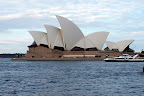
Emma had left us a brochure at the hotel and a note to meet them the next day at the Chinese Gardens. This gave us a chance to discover the Darling Harbour area. It's like a big attraction park; it's got a giant aquarium, a wildlife zoo, an IMAX cinema, the science museum, the maritime museum, a casino, and lots of restaurants. But you can also just sit and relax. We walked down to King Street Wharf and had lunch, then walked some more, to the Rocks and the Sydney harbor area, around the opera and into the Botanical Gardens, where Emma and Laurent left us and we made our way to the NSW state library, which is also an archive center and where they have a photo exhibition on of recent photo-journalism – interesting. That was a lot of walking, so we ended the day there and made our way back to the hotel.
On Saturday morning, Emma and Laurent picked us up in Ashley's car. We dropped our stuff off at their apartment (where we are staying until the very last night, when we return to the hotel, and they are staying at Ashley's) and then headed off to the Blue Mountains.
 The Blue Mountains are just a couple of hours from the city. The "blue" comes from the eucalyptus fumes the trees give off. They are a great get-away for the people of Sydney and, it being Mothers' Day weekend, there were quite a lot of families enjoying a get-away. At Echo Point, there's a view of a very large canyon – much like the Grand Canyon of Pennsylvania, except you didn't have all the magnificent fall colors. Still, it's a beautiful view. We stayed in a fairly decrepit motel from the '60s – expensive and no view. Had a great dinner at an Italian restaurant not too far away. And set off for Hunter Valley the next morning. (In spite of it being Sunday, our motel finished breakfast at 9:00 and set check-out for 10, so we didn't even get a late sleep-in.)
Actually, it took longer than we thought to get to Hunter Valley. I think it's because we stuck to the small winding roads in the mountains. It was certainly beautiful. And on the Hunter Valley side of the mountains we went through fruit orchards and horse farms. It reminded us very much of West Virginia or the Carolinas. As we came further down the mountain, we started seeing more vineyards – not the enormous vineyards of Coonawarra, but more European-sized plantings. What is really strange is that in the center of these vineyards, the center of each label or a group of labels, there is a whole commercial complex (tasting, of course, but also some accommodation, restaurant, and shop with cheese and other refined groceries to go with the wine) replacing the chateau we'd see in France. Emma had reserved a surprise for us – the Crown Plaza – in Hunter Valley and. Especially after the previous night's stay, we really appreciated it. At dinner, we had a local Macquariedale organic (and bio-dynamic) wine, which was very good (like a mellow Bordeaux with a hint of cherry), so on Monday, we set out to find the center which showcased the Macquariedale wines. It was at the Hunter Resort, but what we tasted there was not as good as what we had had at the restaurant, so we tasted some others and Emma and Laurent bought a couple of bottles for themselves and Ashley.
After lunch, we headed back to Sydney. No rush, so we were still on the small roads. We made it back to the city just before sunset – over the famous bridge and back to the apartment. Emma and Laurent showed us where they shopped, where to get the bus and so on. Their studio is on the first floor, but is more like the ground floor, because that is where the garden is and they have a terrace surrounded by palm trees. The real ground floor is the garage and, on the Cleveland St. side, empty commercial space. It's a nice studio with an open kitchen to the right of the door as you come in and the living area to the left. They have room for two sofas, a coffee table, and even a TV in one half and their bed and bedside tables in the other, with the bathroom on the right, behind the kitchen. Very efficiently laid out. And most of the furnishings are things they picked up and put together! It's quite comfortable (but the sofas are not ideal for the over-50s).
On Tuesday, we set out on our own to discover the city. By now, we've exhausted the museums (and ourselves) and we know George Street by heart – on foot and by bus. Emma and Laurent live a couple of blocks from Broadway. Broadway turns into George Street at Central Station and goes all the way up to the Rocks and the harbor. It's probably a little over 4 km from their place to the end. In that space, you go through Chinatown, the financial district, the main shopping and the luxury shopping districts, to end at the main tourist area, the harbor and the Opera. This is the main peninsula of Sydney, the CBD (central business district).
Not far away is Watson's Bay, a few peninsulas over, across from Manly, it is the entrance to the harbor. As such, until recently, it was a military base, so the tip of the peninsula was free of buildings and had been turned into a national park. It's beautiful, with beautiful views – cliffs on the Pacific side and Sydney in the distance on the harbor side. We took a bus to get there and went through some very expensive neighborhoods with some exquisite views. Each bay had its marina and hillside homes. Watson's Bay, being the end of the series, is probably the most exclusive. It's tiny. It's the end of the line for the bus, too. You get off – there's the national park on one side of you and a commons down to the wharf on the other. At the bottom of the hill, at the wharf, there are two restaurants – a fast food fish restaurant on the wharf and a regular fish restaurant with service on the beach. They both belong to the Doyle family. We chose the restaurant with service on the beach. So, you've got the beach at your feet and a spectacular view of Sydney in the distance. Around the marina, you can see some very nice homes, too. We caught the ferry back to Circular Quay, the main Sydney harbor stop between the Opera and the Rocks. The ferry ride back only took a few minutes! We had time to finish visiting the Aboriginal bark paintings at the MCA (Museum of Contemporary Art) and have a coffee break with Emma before walking all the way back to the apartment.
Last day – a fine lunch at Potts Point at the Yellow Bistro with Ashley and her partner, Stu. A big thanks to them for the car for the weekend in the mountains and for having Emma and Laurent so we could stay in the studio.
From Hong Kong, in transit.
Wednesday, May 7, 2008
Uluru (en français)
Cette fois-ci, ça va être plus près de la version originale, car je viens de l'écrire !
 Avant de venir ici et après avoir vu tant de documentaires, nous pensions que nous serions peut-être un peu blasé au vu de Uluru (Ayers Rock). Eh bien, non, pas de tout. Comme tout le monde, on a pris des dizaines de photos qu'il va falloir trier pour ne garder que les meilleurs. A chaque tournant, à chaque changement d'ensoleillement, c'est différent.. Soit on bouge, soit on reste sur place, c'est toujours différent. La couleur dominante est le rouge, mais il y a des rainures noires et des trous qui casse la monotonie et laisse travailler l'imagination. A un endroit, il y a un bout de roche qui a glissé, laissant apparaître du gris et beige à l'intérieur et des coulures de rouge à la surface, comme si on avait tout peint et que le peinture se serait trouvé à cour de peinture.
Sur la route depuis Kings Canyon, il y a une autre montage solitaire, le Mont Connor, que nous avons, à première vu, mépris pour Uluru, tout en pensant que c'était drôlement gros pour être encore si loin (plus de 100km.). Une fois le mystère résolu au "point de vue Mt. Connor", nous sommes repartis et Uluru est bien visible de très loin. Cette fois-ci, par contre, on a bien reconnu la forme. Et aussi loin sur la droite est une autres formation qui ressemble à un tas d'œufs. Il s'agit de Kata Tjuta (Les Monts Olgas) et notre impression d'œufs n'était pas trop loin car cela correspond bien à l'histoire de la création locale selon les Anangu (Aborigènes, dans leur langue).
Il y a quelque chose dans ces histoires de création qui sont très similaires aux histoires de la création dans la tradition Navajo. Je me demande si quelqu'un aurait fait une étude comparative entre les histoires des aborigènes en Australie et le amérindiens.
Sur la route ici, nous avons vu des chameaux (dromadaires, pour être précis) qui mangeait dans les arbres. Nous savions qu'il y a des chameaux sauvage (On en a importé en Australie au milieu du 19è siècle et des échappés se sont multiplié. Ils sont environ 500 000.) et nous avions suspecté qu'ils étaient peut-être les animaux qui laissaient de si grosses traces de leur passage et en si grande quantité.
Nous avons aussi remarqué un arbre, que j'avais pris, à première vu, pour un pin. L'arbre mature ne ressemble pas à l'arbre jeune. Il commence sa vie comme une arbuste en forme de goupillon pour biberons – tout couvert de feuilles. Au fur et à mesure qu'il pousse, il continue à porter ses feuilles sur tout le tronc (des feuilles tellement fin et long que je les prenait pour des aiguilles de pin). C'est ce qui lui donne son apparence d'arbuste. Enfin, vers 4 ou 5 mètres de haut, il perd les feuilles vers le bas de son tronc et commence à former ses branches, mais c'est encore un arbre fin. Ensuite, à maturité, les branches prennent forme et les feuilles ne poussent qu'à leurs extrémités. C'est enfin un arbre, une espèce de chêne. Ce que je croyait être des pommes de pin sont, parait-il, des glands en bouquet.
Nous avons fait le tour d'Uluru et presque tout un tour autour de Kata Tjuta. Nous avons vu le coucher de soleil sur Uluru hier soir et le lever ce matin. Nous avons passés un bon moment au centre culturel, qui est très bien fait. Je sais que je comprends mieux les Anangu (Aborigènes). J'aurais voulu marcher un peu plus, mais ce n'est pas un bon jour pour moi, alors j'ai eu le temps d'écrire et de charger les photos sur la clé USB. Cet après-midi, repos et demain, Sydney, où on retrouve Emma et Laurent.
06-07/05/08 – Uluru
We thought, before coming, that, having seen so many documentaries about Uluru (Ayers Rock), we might be blasé. Well, no, not at all. We took dozens of pictures, just like everyone else (I'll try to keep only the good ones!) because at every turn, at every change in sunlight, it's different. So you can be moving around it and it changes or just standing in one spot and it changes. The dominant color is red, but there are black streaks running down and holes in the surface that break the uniformity and let you work your imagination. At one point, there's some rock that fell away, showing some gray and tan inside and reddish drips on the surface, as if the whole thing was painted and the painter ran out of rust color. On the way from Kings Canyon, there's another solitary mountain, Mt. Connor, which at first, we mistook for Uluru, thinking that it was awfully big for such a distance (still more than 100 km to go). Once that matter was cleared up at Mt. Connor lookout, we continued on and Uluru is indeed visible from very far away. This time, however, we did recognize the shape better. And off to the side is another formation, which look like gigantic eggs. That's Kata Tjuta (The Olgas) and our impression of eggs was not too far off base because that is the local creation story.
Something about these creation stories – they are very similar to the Navajo creation stories. I wonder if anyone has done any comparative studies between Australian Aborigine and Native American stories.
On our way here we spotted some wild camels grazing. We knew there were wild camels and had even speculated that the large animals that left such large deposits along the roads might be camels. We also noticed that a tree, that I thought, at first, was a pine, looks very different when it is not yet a mature tree. It starts out as a bottle-brush-looking bush. As it grows taller, it continues to sprout leaves (they are so narrow and long, I mistook them for pine needles) all along its trunk. That gives it its tall bush appearance. Finally, at about 4-5 meters high, it loses the leaves on the lower trunk and starts forming branches at the top, but it's still a tall, narrow tree. Then, the branches become more hefty and leaves only grow at the extremities of them – finally a tree, an kind of oak, it seems. (What I took for pine cones are clustered acorns.)
We have now driven around Uluru and almost around Kata Tjuta. We took in the sunset last night and the sunrise this morning at Uluru. We have visited the cultural center, which is quite well organized. I know that I have a better understanding of the Anangu (Aborigines). I really would have liked to walk a bit more than we have, but today is not the day for me, so I have had time to write and load up some photos and we haven't had lunch yet. This afternoon, R&R. Tomorrow, we're off to Sydney and reunion with Emma and Laurent.
Tuesday, May 6, 2008
Encore un peu du voyage raconté en français
Maxence, Eléonore, Laure-Hélène, Maxime et Valentine : vous êtes tous invités à m'écrire pour me faire des remarques concernant mon orthographe et grammaire. Je fais autant pour vous en anglais alors c'est le moment de prendre votre revanche – gentiment !
Je me répète peut-être, mais ce que j'écris en français n'est pas forcément la même chose que j'ai écrite en anglais. Avec plus de recul, j'organise mes pensées autrement.
Kangaroo Island
Une vraie aventure. Levés à 5h30 pour être à l'heure au rendez-vous du bus peu après 6h. Et encore, on était les derniers à être pris. Les autres dans le bus se sont levés encore plus tôt ! Petit arrêt au terminal du bus pour chercher les passes pour le ferry à deux heures de route. Il était 10h le temps de traverser et trouver notre guide/chauffeur. Petit groupe: nous deux, un jeune danois et le guide.
Kangaroo Island fut découvert par Matthew Flinders juste avant le français, Nicolas Baudin. Son équipage crevait de faim et comme il n'y avait pas de fumer (donc pas d'aborigènes), il a osé atterrir. Comme il a trouvé plein de viande, il a nommé l'ile en conséquence. Il a rencontré Baudin quelques semaines plus tard et lui a recommandé l'arrêt pour ravitaillement, ce qui explique pourquoi il y a beaucoup de noms français aussi sur les points de l'île. En tout cas, mise à part l'abondance de kangaroo, Flinders n'a pas trouvé les perspectives de l'île très prometteuses – d'où le nom de Pospect Hill, une très haute dune de sable d'où on voit assez de l'ile pour s'apercevoir qu'elle n'est pas bonne pour l'agriculture.
Il y a pleins d'anecdotes, comme celle du touriste qui s'est éloigné de son groupe et dont les restes ont été enfin trouvées deux ans plus tard (identifiées par sa montre). On a nommé un très joli lagon en sa mémoire.
Il y a une distillerie d'eucalyptus. Autrefois c'était la grande industrie de l'île qui a disparue vers le milieu du 20è siècle. Cette ferme en difficulté à cause de la sécheresse la ré découverte dans les années 90. Une odeur de Vicks domine. Ces fermiers ont, en ce moment, un "joey", un petit kangourou qu'ils élèvent depuis que la mère fut fauchée par une voiture. Millie, ce petit, a environ un an maintenant.
Au choses sérieuses – à commencer par les koalas. On en a vu dans un endroit qu'ils apprécient – six ou sept, mais tellement haut dans les arbres que nous étions content d'avoir pu photographier celui de l'autre jour qui était tout près et qui bougeait. Je deviens assez bonne pour les trouver. On a poursuivi en rendant visite aux lions de mer, sur leur plage de repos. Les lions de mer passe trois jours en mer à manger et trois jours sur la plage à dormir. C'est aussi sur la plage que les "pups" (les chiots – en effet, ils sont apparentés aux chien !) peuvent téter. Quand leur mères sont en mer, les petits restent sur la plage. Il semblerait qu'ils n'ont pas de prédateurs et ils sont en sécurité pendant les trois jours..
L'île, c'est du sable. Il y a un endroit qui s'appelle "Little Sahara" – de grandes dunes de sable très fin et très blanc. On fait du snowboard sur les dunes.
En décembre dernier, il n'y a que 5 mois, il y a eu une grande incendie qui à dévasté 20 pour cent de île. On le voit partout. Mais en regardant au niveau de la terre, on voit beaucoup de verdure. Ce sont des arbres "mallee". Le tronc est sous terre. Quand les branches brulent, l'arbre fait repousser de nouvelles branches tout de suite. On en a vu dans les Grampians aussi. C'est assez spectaculaire.
Le soir, après le diner on s'est promené pour voir les animaux nocturnes : kangourous, wallabies, opossums. Et on a pu admirer le ciel – pas de lumière urbaine pour gêner. Que des étoiles !
Le parc national de Flinders Chase a été entièrement brulé par l'incendie de décembre. D'ailleurs, ils viennent de rouvrir l'accès. La régénération est évident partout – les arbres "mallee", les grands arbres couverts de feuilles partout et les "yaccas", une plante grasse, qui ne fleurissent qu'après une grande détresse sont en fleur.
En plus de la faune et la flore, il y a la géologie. On s'est arrêté un moment à "Remarkable Rocks" et ils étaient tout à fait remarquable. A l'époque où le niveau de la terre était bien plus élevé, il y a des millions d'années, un volcan a commencé son percé mais s'est arrêté avant de percer et d'exploser. A ce stade, c'était de la granite à l'état magmatique (en exposons, ce serait transformé en autre roche) et il a formé une dôme à plusieurs couche. Dans le magma étaient des roches plus lourde que le granite. Avec le temps et l'érosion, la dôme s'est pelé; les roches plus lourdes sont tombés en laissant des formes parfaites dans le granite au dessus; et les des grosses roches de granites sont exposé à notre vue. J'ai pris les photos des fiches explicatives pour ceux qui feraient des exposés !
Au Cap de Couderic (un des endroits nommé par Nicolas Baudin) ils ont construit un phare en 1906. Il y avait le responsable du phare et ses deux assistants et leurs familles. Ils étaient ravitaillés tous les 3 mois. Pour hisser le ravitaillement, ils on creusé une tranché dans la falaise – on le voit très bien. La route n'a été percée que dans les années 1940. Notre guide nous a expliqué pourquoi les tenanciers de phares devenait fous. Ce n'était pas seulement à cause de la solitude; c'était aussi dû à l'utilisation de mercure dans le fonctionnement du phare. Même les membres des familles auraient été intoxiqués par le mercure. Il y a une expression en anglais : "mad as a hatter" (aussi on retrouve le "Madhatter" dans Alice au pays du merveille) qui vient du fait que les chapeliers utilisait le mercure pour former les chapeaux.
Sur les rochers sous la phare se trouve une colonie de phoques à pelisse de Nouvelle Zélande. (Je ne vais pas rentrer dans la différence entre les lions de mer et les phoques.) Ces phoques ont été chassés jusqu'à leur quasi extinction, mais sont en train de bien revenir. Les lions de mer que nous avons vu la veille étaient bien en vue sur la plage ; ces phoques ont une peau brun foncé et ils se reposent sur des pierres brun foncé – donc difficile à voir.
On a bien vu la forêt de l'intérieur pendant une promenade vers la rivière (bon, fleuve pour les puristes). Il y a encore peu d'eau. Ce qui était encore remarquable était la ré génération de la forêt. Et c'était suivi d'une autre promenade sur une plage à sable fin et très blanc. De loin on aurait dit une plage d'une île tropicale à l'eau transparente et chaude. Transparente, oui; chaude, certainement pas.
Cette île a aussi une grotte à visiter. C'est une grotte sèche, donc on a des stalactites et des stalagmites et une formation unique au grottes sèches : des helico... (quand je trouverai un accès à l'Internet où j'ai un peu de temps devant moi, je chercherai le mot). Ils démarrent comme stalactites mais, n'ayant pas assez d'eau pour continuer à "goutter", ils se dessèchent à l'arrivée de l'eau de nouveau, ils croissent par l'action capillaire qui fait remonter ou étendre à l'horizontale la poussée de la formation.
L'outback
Alice Springs, surtout un samedi, n'était pas d'un grand intérêt pour nous. Peut-être pour des plus jeunes, mais pour nous, c'était surtout une journée de repos.
Cela dit, le vol depuis Adélaïde était très intéressant. On dit que les peintures des aborigènes sont en fait de la cartographie du terrain, comme si on regardait d'en haut. Eh bien, on peut le voir depuis l'avion. Les collines sont très foncés, les sources d'eau, lacs et rivières à secs sont très clairs. Le reste est rouge. Chaque arbre se détache en point (noir depuis le ciel). On voit des points isolés et des points très rapprochés, si bien qu'on devine la course des rivières par la densité des points. Vu du ciel, le système d'une rivière avec ses tributaires ressemble lui-même à un arbre. De temps en temps on voit des points d'eau qui réfléchissent la lumière.
Pour ceux qui sont ornithologues parmi vous, jetez un coup d'œil sur les photos (j'annoncerai quand je télécharge le lot suivant). Ils sont très colorés mais je ne sais pas ce qu'ils sont. Aidez-moi.
Nous avons quittés Alice Springs à bord de notre 4x4 pour aller vers Uluru (Ayers Rock). Après la désolation (même si la ré génération est spectaculaire) des forêts incendiés des Grapians et Kangaroo Island et la terre surexploitée des élevages, ici c'est luxuriant. Bien sur il y a des indices d'incendies dans le passé, mais pas sur une si vaste térritoire. Les arbres mallee ont presque atteint leur taille normale. Il y a des "red gums" (eucalyptus) partout et en bonne santé. Il y a beaucoup de variétés d'herbes et des arbustes qui recouvrent la terre. Tout est vert – depuis le vert des nouvelle pousses, le gris-vert plus vieux couvert de poussière, au vert bruni de la fin de saison. Il y a aussi des termitières bien hautes est visible depuis la route et des courges qui poussent aussi le long de la route. (Ces melons sont soit toxiques soit simplement immangeables, selon qui vous le raconte.)
En route vers Glen Helen (première nuit de halte), nous nous sommes arrêté à Simpsons Gap, encore tout près de Alice Springs. On s'est promené le long d'un lit de rivière à sec – que du sable clair. Les roches tout autour sont rouge – toutes sortes de rouge. Le lit de la rivière était vraiment très sec, pourtant, des animaux (sans doute des wallabies) avaient creusé à peine et avaient fait remonter de l'eau. Un photographe se mettait en place pour prendre des photos de sa modèle installée sur les rochers. Il lui a fait remarqué qu'il y avait un wallaby sur un rocher derrière – erreur de sa part, car nous et les autres touristes se sont mis à chercher le wallaby et lui, était prêt de prendre ses photos et demandait au modèle d'enlever son t-shirt. Heureusement, nous, les touristes ne s'intéressait vraiment qu'au wallaby. Le gap se termine en gorge étroite avec une accumulation d'eau en permanence avec une végétation remarquablement vert. Au retour on a vu qu'il y avait, en fait, trois wallabies dans les rochers. J'ai eu beaucoup de chance en les photographiant.
Un peu plus loin sur la route, avant d'arriver à Standley Chasm, un kangourou est sorti sur la route devant la voiture. C'était un grand. Nous (et lui) avons eu de la chance qu'on ne l'a pas touché. On en a vu un autre le matin en quittant Glen Helen et aussi on a vu un dingo. Mais, voir ces animaux en plein jour c'est rare.
Stanley Chasm nous a rappelé étrangement Petra. On suit encore une rivière à sec. Le lit de celui-ci est bordé par une densité d'arbres, d'herbes et de plantes grasses tout le long et ne donne pas l'impression aussi sec que l'autre. D'ailleurs, à un point on croise un ruisseau avec de l'eau. C'était presque tropicale. On monte un peu dans un canyon de plus en plus étroit avant d'arriver à la brêche et puis on se retrouve entre deux murs au passage très étroit, mais à la sortie il n'y avait pas de mausolés comme à Pétra. C'était très beau.
Les aborigènes se décorent à l'ocre pour leurs cérémonies et nous avons pu voir un site, Ochre Pits (les mines d'ocre) sur la route. On n'a pas le droit de toucher, ni de ramasser, bien sur; c'est un site sacré. Mais c'est spectaculaire de voir ces arcs en ciel de pierre qui sont les différents couleurs d'ocre.
A Glen Helen, il y a encore une gorge avec une source d'eau permanente. Le lit de la rivière n'est pas sablonneux, mais caillouteux. Et encore, c'est cailloux n'ont aucune relation avec les pierres environnants. Il pousse une herbe très haute – si j'ai bien compris, c'est une herbe importée il y a longtemps pour nourrir les chameaux. A la gorge, il reste assez d'eau pour en faire une piscine, faire survivre 4 espèces de poissons, et nourrir au moins 3 canards (que nous avons vu). Paul pensait à Mexican Hat – un hôtel avec son bar et restaurant et son station service. La concurrence est à plus de 150 km à Alice Springs ou à près de 370 km à Kings Canyon.
Justement, Kings Canyon, l'arrêt suivant. Il y a moins d'arrêts en route. On a vu le kangourou du jour et le dingo, et plus tard, à l'hôtel, des traces dans le sable de maras (tout petits wallabies). Ce qui nous a encore une fois impressionné c'était la verdure. On nous a dit qu'il n'avait pas plu depuis novembre, pourtant il y a une verdure toute fraîche, des arbres dont les variétés changent à chaque vallée, des herbe, ces melons qui poussent au bord de la route. Partout le long de la route, des crottes – il y a une population animale considérable dans cette brousse – y compris de très gros, si on juge par leur déjections.
La route entre Glen Helen et Kings Canyon et presque entièrement en terre – sable et cailloux. L'effet de corrugation est indescriptible. On l'a déjà subit ailleurs, même sur des chemins chez nous, mais là, c'était pendant des kilomètres et kilomètres. Rouler sur les accotements plus sablonneux semblait plus confortable. De coup, la route est très large, car chacun cherche son confort de plus en plus sur le côté.
On s'est arrêté à Gosse Bluff (Tnorala); le cratère d'une comète qui à frappait la terre il y a 145 millions d'années. Au bout de tant d'années d'érosion, il ne reste plus grand chose ; nous étions comme dans une très large assiette à soupe bordé de montagnes.
Friday, March 14, 2008
Back to Work?
Just home from the hospital (operation successful) and saw a job offer on the STC France site. Since they are looking for someone for only six months, from May to November, I thought I should look into it. When I clicked the link to email my resumé, I noticed that I knew the addressee - in fact, when she was just starting out as a technical writer and was a bit in a panic about using FrameMaker, I met with her and helped her through the beginning of it. We have exchanged several emails since yesterday and it looks like I may very well be in the running for her job when she is off on maternity leave. Just when you least expect something, it just turns up.
Of course, if it doesn't pan out it's no great catastrophe either. Paul thinks that he might start his retirement with our trip to Australia. He has so much vacation and untaken RTT days (those are the days off one gets to create the illusion of a 35-hour week) that he must take before retirement, that he could stop working in April and not officially retire until late fall.
Also, I was thinking of getting back to the States for a visit sometime during the summer. I got an email from Erica suggesting a bunch of us Girls' High orchestra girls try to meet in August. I'd like to do that and go to Pittsburgh. If Paul were with me, we could then continue on a bit of vacation elsewhere. If I took this job, I wouldn't be able to do it.
While at the hospital, I read several Alexander McCall Smith novels -- mostly the ones from the No.1 Ladies Detective Agency series. They are very pleasant reading -- ideal for the hospital, actually, when you can't concentrate on heavy stuff. I'm also trying to finish The Fatal Shore, about Australia, but keep getting bogged down in it and not advancing.
Of course, if it doesn't pan out it's no great catastrophe either. Paul thinks that he might start his retirement with our trip to Australia. He has so much vacation and untaken RTT days (those are the days off one gets to create the illusion of a 35-hour week) that he must take before retirement, that he could stop working in April and not officially retire until late fall.
Also, I was thinking of getting back to the States for a visit sometime during the summer. I got an email from Erica suggesting a bunch of us Girls' High orchestra girls try to meet in August. I'd like to do that and go to Pittsburgh. If Paul were with me, we could then continue on a bit of vacation elsewhere. If I took this job, I wouldn't be able to do it.
While at the hospital, I read several Alexander McCall Smith novels -- mostly the ones from the No.1 Ladies Detective Agency series. They are very pleasant reading -- ideal for the hospital, actually, when you can't concentrate on heavy stuff. I'm also trying to finish The Fatal Shore, about Australia, but keep getting bogged down in it and not advancing.
Saturday, March 1, 2008
Spring is around the corner.
Everything is in bloom - well, almost everything. The lilacs are not out, yet. But many of the trees are blooming. It's too soon. They say that the next week is going to be really cold. I hope this doesn't wreck the fruit trees and make fruit even more expensive. In any case, it's lovely to see all the spring colors already. At the end of the month, we go back to summer time, too. I always love that.
I've been working hard on the trip to Australia. It's going to be a full month from mid-April to mid-May. It'll be fall, there, but it shouldn't be too chilly, yet. Emma says they've has lots of rain this year. They needed it. We're getting very excited about the trip. Bill Bryson's Down Under is a good introduction - very funny, as most of his books are. Many years ago I read Bruce Chatwin's The Songlines and I think that was the book that made me want to visit some day, although the trip we have organized is not at all influenced by it. For one thing, we can't see much of Australia in a month, so we're not trying to.
The STC France conference is coming up really soon - in just two weeks. Normally, I'd be looking forward to it, but this year, I don't think I'll be able to attend. I've got an operation coming up this week and am not sure exactly how soon after that I'll be very active.
What else? I saw my friend, Oriane, yesterday. She came up to Paris from Lyon for one of her linguistic workshops. It was canceled, but since she had her ticket, she came up anyway to celebrate her birthday with friends. We walked from the Gare de Lyon to les Halles and stopped on our way at the Pompidou museum. There was an exhibit called "Les Inquiets" (The Anxious) - photographs and video by Palestinian and Lebanese artists. The videos were disturbing - one was about the reality and fiction of martyrdom - how the suicide bombers spend so much time setting up and doing several takes of their video message, as if the video were more important than the act. Gruesome.
Next to that exhibit there was another exhibit of Richard Rogers 48 years of Architecture, including, of course, the Pompidou Center, itself. That was much more interesting to me. There was a model that showed you how the area south of Shanghai, Pudong, was supposed to work, the different transportation systems, the distribution of space for residential, office, commercial, leisure, and cultural uses. There was another model of central London as he thought of it. Interesting.
That's about all. It was nice to see Dan leave a comment on the blog and it's always nice to get your e-mail when you want to react to an entry privately.
I've been working hard on the trip to Australia. It's going to be a full month from mid-April to mid-May. It'll be fall, there, but it shouldn't be too chilly, yet. Emma says they've has lots of rain this year. They needed it. We're getting very excited about the trip. Bill Bryson's Down Under is a good introduction - very funny, as most of his books are. Many years ago I read Bruce Chatwin's The Songlines and I think that was the book that made me want to visit some day, although the trip we have organized is not at all influenced by it. For one thing, we can't see much of Australia in a month, so we're not trying to.
The STC France conference is coming up really soon - in just two weeks. Normally, I'd be looking forward to it, but this year, I don't think I'll be able to attend. I've got an operation coming up this week and am not sure exactly how soon after that I'll be very active.
What else? I saw my friend, Oriane, yesterday. She came up to Paris from Lyon for one of her linguistic workshops. It was canceled, but since she had her ticket, she came up anyway to celebrate her birthday with friends. We walked from the Gare de Lyon to les Halles and stopped on our way at the Pompidou museum. There was an exhibit called "Les Inquiets" (The Anxious) - photographs and video by Palestinian and Lebanese artists. The videos were disturbing - one was about the reality and fiction of martyrdom - how the suicide bombers spend so much time setting up and doing several takes of their video message, as if the video were more important than the act. Gruesome.
Next to that exhibit there was another exhibit of Richard Rogers 48 years of Architecture, including, of course, the Pompidou Center, itself. That was much more interesting to me. There was a model that showed you how the area south of Shanghai, Pudong, was supposed to work, the different transportation systems, the distribution of space for residential, office, commercial, leisure, and cultural uses. There was another model of central London as he thought of it. Interesting.
That's about all. It was nice to see Dan leave a comment on the blog and it's always nice to get your e-mail when you want to react to an entry privately.
Subscribe to:
Posts (Atom)