Showing posts with label Malta. Show all posts

Saturday, November 1, 2014

A week in Malta - 1

(Je ferais un autre article en français)
This is a special trip for us. Paul and I met at the Pierwige Hotel (it no longer exists -- it's private apartments with a bank on the ground floor, now) in 1970. Paul was an engineering student in a program at the school next door. Other students at that school were also living at the hotel. J-P, already engaged to R, who lived with her parents but who spent most of her free time with the Pierwige group; F, who was already engaged to C, but she was not living in Paris, yet; G, and Y. They were not the only ones, but they were the core and they've kept in touch with one another, while we lost contact until a year or so ago, when I was scanning our negatives and came across a trove of Paul's photos from that time, before I came on the scene. I googled and found a phone number for one of J-P and R's sons and we were able to reconnect with J-P and R. At a dinner at their home, we saw with F and C for the first time in 40 years. So, it was decided we'd all go on a trip together: 5 couples.
From the rampart near the hotel. (Look at the photos in the wikipedia links below for better pictures than mine.)
We decided to go to Malta. October is an ideal time to visit Malta. It's hot, but not as hot as in summer. There are far fewer tourists, although there are enough to keep restaurants full. Y and M arrived separately from Lyons; the rest of us met up at Orly for the flight from Paris. It was a late flight, so it was already dark when we arrived. Y and M had arrived early and had already cased out Valletta and found a restaurant for our first dinner all together.
We made some elementary tourist mistakes. We are 5 couples, 10 individuals, not a group of 10 with a tour guide. We decided to buy 2-day tickets for one of the hop-on, hop-off bus tours, but the receptionist at our hotel sold us one ticket for 10, which meant we all had to hop on and hop off together. Of course, in a group of 10, not everyone wants to do the same thing at the same time, and discussions about where to eat and what to do can drag on, but on the whole, we all got along and there was a lot of give and take. It wasn't a problem, but it would have been easier on me, the ticket holder, if each couple were responsible for its ticket. For any readers planning on visiting Malta, if you want to take the hop-on, hop-off tour, don't get the tickets from the hotel; there are at least two competitors, so you may want to choose which company you take, and if you're traveling with friends, you might want to be more independent so that you don't wait around or make them wait for you. Then again, you might consider not taking the tourist bus and getting a day ticket for the public bus service -- much, much less expensive (only €1,50). Since distances are so short, you can always find a bus to get you to the same sites as the tourist bus, and not have to wait so long for the next bus to come by.
The first day, Monday, we took the southern tour. Malta is tiny; there's not much distance to cover, but you can't hop-off at each stop because you won't really be able to visit. We didn't get off at the Tarxien ("x" is pronounce "sh") temples, which we thought we'd visit later, nor at Marsaxlokk, a beautiful little port known for its fish menus, which were not really calling us at 10 something in the morning. We got off at the blue grotto, not to visit the grotto, but to just to get off, walk around, and have a drink, which meant getting the next bus, or maybe the one after. I don't remember. We got off, again, at the next stop to visit the Hagar Qim and Mnajdra temples.
These two temples date from about 3600 BC, with evidence that the site was used for some rites even as far back as 4000 BC; that's almost 6000 years. That's about 1500 to 2000 years older than Stonehenge! They are definitely structures that were built for religious rite; the main doors and inner openings line up with the summer solstice and other openings with the equinoxes. They are made of huge blocs of stone that seem to have been transported by placing them on round stones that are found around the sites. Other stones are rutted and seem to show that the round stones rolled somewhat, like ball bearings. The temple layout is the same all over Malta and Gozo -- a main entrance with two round inner chambers, then another passage and two more round inner chambers. The stones that mark the doorways have handles carved into them that probably held rope for cloth to close off the passage. The decoration is simple, dots, but sometimes these dots form spirals. In other instances, the dots seem to form a counting system, maybe a calendar. There are altars and indications of fire, perhaps for animal sacrifice (they found animal bones, too). There are indentations for the feet, where there were once large statues of women -- Botero-like women, very buxom and hefty (we saw them, later, at the Archeology Museum). At the site of the older of the two temples, Mnajdra, the one down the hill, closer to the sea, the archaeologists found the evidence of bones, even dwarf elephant bones, going back to 4000 BC. So, Hagar Qim is deemed the more recent site.
Needless to say, this was a long and interesting visit. By the time we all finished, it was well past lunch time, but just across the parking lot was a restaurant and, for a place where you feel you are a captive customer having no choice to go elsewhere, it was very good! We managed to hop on the next to last bus back to town. Just remember that if you want to visit, you can get a public transport bus from Valletta to the site. They only thing you'll miss out on is the commentary.
Once back in Valletta, we cleaned up, rested, and met later for dinner.
Links to Wikipedia articles that might be of interest to you:
Malta, general article
Valletta
Hagar Qim
Mnajdra

Friday, October 24, 2014

Week in Malta - 2

Where to eat? A twice daily question. It was hot and humid and we didn't want to be inside, so that limited us a bit. There were 10 of us, so that limited us further. There are lots and lots of restaurants in Valletta, but the ones that can manage to seat 10 are on the main squares. They are good, but not fantastic. I didn't have a single bad meal, but I didn't have a single exceptionally excellent one, either. Servings tend to be enormous.
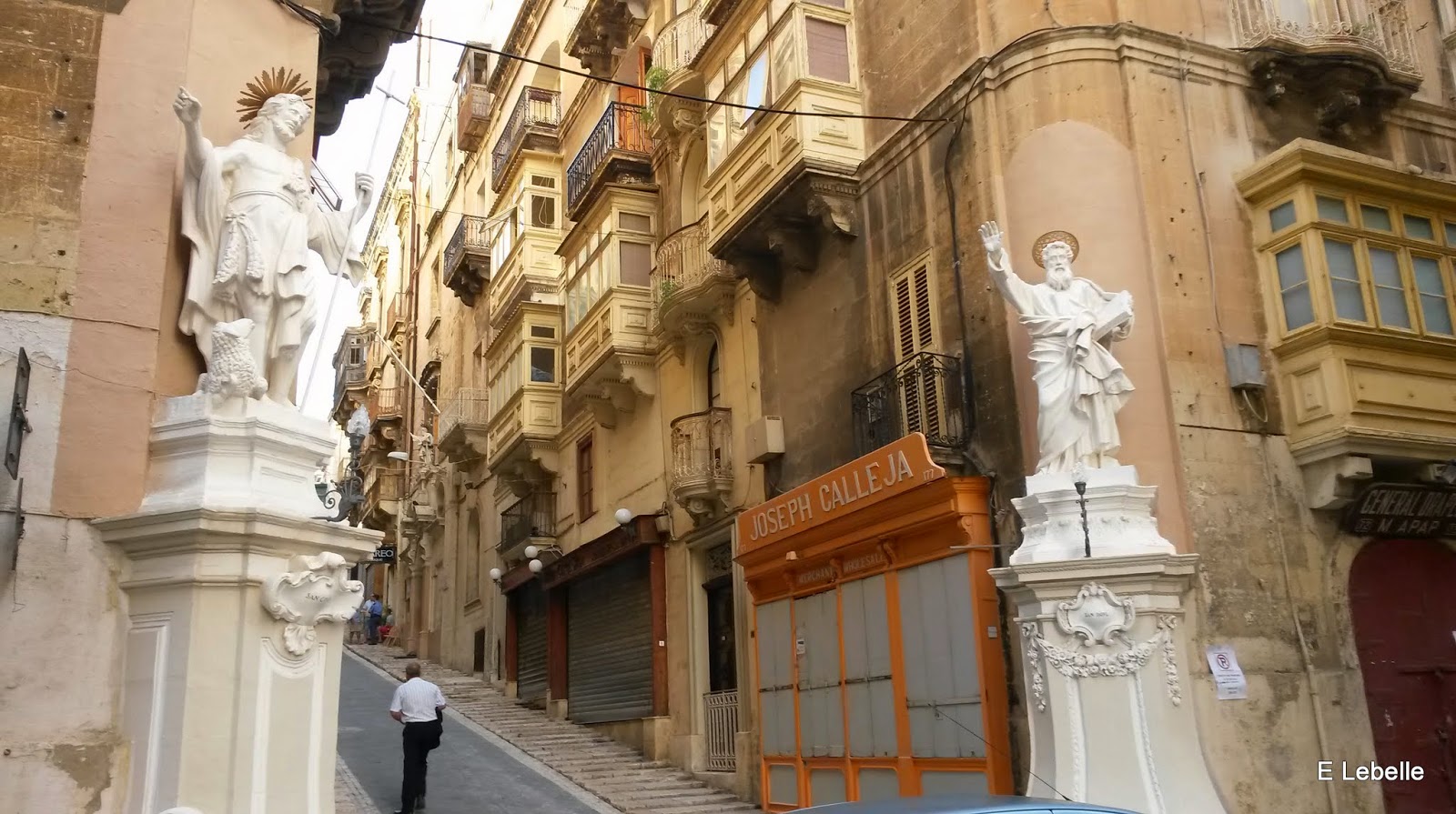
Tuesday we decided to do things at our own pace. One couple went off to visit the Tarxien temples and discover the coast, have a swim.... Paul and I headed out early after breakfast to walk through the streets before it got too hot. I wanted to see the church of St. Paul the Shipwrecked (tradition has it that St. Paul shipwrecked on Malta), but there was a mass going on, so tourists were asked to wait. We walked on. Everywhere you turn, there's another church. The island was under the rule of the Knights of the Order of St. John, a hospital order that was dedicated to healing people (like Medecins sans Frontières, today?). They had to defend themselves, so it was also a military order, of course. They built forts and churches and magnificant palaces, called "auberges" for each country or province they came from. We found the market, but there is restoration work going on, so there was no real food market going on, just a few butchers, fish mongers, and poultry dealers open for business. On the street, Merchant Street, there was an open market, but no food, just clothing, batteries, toys...
Before 9, we were already waiting for the Palace of the Grand Master to open at 9, but it didn't, so we headed on to the co-Cathedral and waited for it to open at 9:30; which it did. The Cathedral is a baroque masterpiece: ceiling and upper wall frescoes by Mattia Preti illustrating the life of St. John; marble floors with the tombs of 400 knights, all different and colorful: lots of side chapels representing the countries and provinces of the knights' origins; and lots and lots of gold all over. It's a co-cathedral, because the arch-bishop resides in Mdina, which was the capital before the order built Valletta and which has its cathedral. Caravaggio was, for a time, a member of the order and he painted the "Beheading of St. John the Baptist" and "St. Jerome" in the early 17th century. His paintings are dark; the only highlight in both of them being the red cloth. Personally, I can't stand the gore of  many religious paintings and seeing John the Baptist being behead does not draw my attention. I preferred "St. Jerome" by far. He's the one who is credited with translating the bible from Greek to Latin.
From the Cathedral, we strolled down the main street,Triq (street) Republika, to the Archeology Museum. The visit there gave me a better understanding of the temples we had seen and the ones we were going to see, later. After the civilization that built those temples left (Why did they go? fire, earthquake, disease? Where did they go? further north to Carnac and Stonehenge?), others came: Phoenicians; Romans; early Christians; Arabs; Normans; the Knights; the French (Napoleon's army stayed two years); the English from 1800 to 1979. The Maltese language is, apparently, a Semitic language written with the Latin alphabet. In this museum, they have the gigantic neolithic statues from the temples and many smaller statuettes. There are some statuettes of pregnant women and on the backs of these statuettes, marks that seem to indicate the pregnancy calendar. There is one, who looks very close to the end of her pregnancy and she does have nine marks. Interesting. There is also a very small statuette of a woman lying on her side -- absolutely beautiful. That's what struck me in this visit, but there is also the pottery from all the different civilisations, and all the other things one finds in an archeology museum.
On the way back to the hotel, we dropped in at the Fine Arts Museum, almost next to our hotel, and met up with the rest of the group, who had done things differently in the morning. Valletta is very small, so it's not surprising that we ended up in the same place at the end! There are a lot of dark, badly lit, gory religious paintings, portraits of the Grand Masters of the Order, and some very pleasant paintings of views of Malta, including one watercolor sketch by Turner, who never visited. As we checked in with our "Heritage" tickets (bought at the first visit, at Hagar Qim in our case, it's a
multi-visit ticket), we discovered that there was a slight chance of getting to see the Hypogeum. Pleyel, and Dancla performed by a young violinist and an equally young cellist, both excellent musicians. It was a short concert and a good appetizer, so we all (well, 8, not 10) went off to lunch.
Normally, one must reserve that when planning the trip to Malta because the number of tourists allowed each day is restricted. We had been told there was no chance of our getting in. However, everyday, there are 20 tickets available for the noon and 4pm tours. People line up long before this museum opens to get these tickets for the following day. That evening, we decided that Paul and I would try to get us tickets for the Saturday visit. After this museum, we returned to the hotel to freshen up (I can't get over how hot and humid it is!) before going to the St. Francis church oratory for a noon concert of Vivaldi, Bach, Handel,
Links to Wikipedia articles that might be of interest to you:
Malta, general article
Valletta
Hagar Qim
Mnajdra
Co-cathedral St. John
Museum of Fine Art
National Museum of Archeology

A week in Malta - 4

Early Friday morning, Paul and I took turns waiting for the Fine Arts Museum to open. This was not to visit the museum again; once was really enough. We were trying to get tickets for the Hypogeum for the next day. If you haven't reserved well in advance, this is the only way you can get last-minute tickets. The first person in line had gotten there at 5:45 and Paul was there at 6:50, number 4 in line. There were two hotel reps before him. Since there are only 20 tickets for sale, I felt very self-conscious that we were trying to take 10. The people who came after us had very little chance of getting any, at all. And we were lucky! Four could visit at noon and six at 4:00 on Saturday! There was one place left and, we found out on Saturday, that went to the last person in line, the only single!
After Paul and I got the tickets for the Hypogeum and put them safely away in the room, we all headed down to the port to get the ferry over to Sliema for the Captain Morgan Harbour Cruise. This gives you a good feel for the geography of the peninsula and islands; there are many ports, in fact. There was one filled with yachts taking part in the race on Saturday; they were all decked out with sponsor flags -- Rolex. There are also a few military boats, which are used mostly for rescue missions as Malta is an emergency landing place for refugees from North Africa. Cruise vessels also spend a day in Malta. They are gigantic! They hide the waterfront. They spit out tons of diesel as they enter or leave the port. That said, the view from the ships must be beautiful and friends who have been on such large cruise ships say they loved the trip. We had lunch at a little hidden snack bar on the main street of Sliema before catching the ferry back to Valletta, where some of us went to visit the state rooms in the Grand Master's Palace and the armory. Actually, we kept encountering one another: Valletta is small, so we had time for an ice cream or coffee to compare impressions. I was struck by the decorative beauty of the armor and arms. The Knights of Malta were a rich order and when a knight died, the order inherited his armor, so it's an impressive collection, even after the passage of Napoleon at the end of the 18th century and the English, from 1800. The helmuts and full body armor was made of heavy metal and engraved, decorated with pearls and stones, and sometimes gilded. The pistols, lances, crossbows, and cannons were elegant and also expansively end expensively decorated. All this to go to battle!
Saturday, we met up at the bus station to catch the bus to Paola: 6 to visit Tarxien and 4 for the Hypogeum. We were in the first group for the Hypogeum. This is an underground temple/catacomb dug into the rock. It's an exact replica of the temples above ground, complete with roof structure and decorations. It boggles the mind to think of how they managed to dig into the rock. It's already mind-boggling when you see what they did above ground. It may have been a temple at the start but it was used later to dispose of bodies. There is speculation as to whether the bodies were deposited there to decompose and then the bones were pushed aside to make room for more or if the bodies were allowed to dry before being placed underground. If they decomposed in the crypt, then the stench must have been horrible, especially as the structure was constantly being extended with new digging. This is where the statuettes were found, such as the woman lying on a couch, which is only about 10 cm. (4 in.) long and is beautiful.
We all met up for lunch in Marsaxlokk, the fishing port on the southern coast. The first six arrived early and were finishing up when we four arrived, so we had our own leisurely lunch of fresh fish. It was a good thing we split up like this because the six had to get back to visit the Hypogeum and they caught the bus that got them there early. If they had waited with us, they would have gotten the next bus, which was running late and they would have missed their tour. As it was, Paul and I got to Tarxien in a rush at 4:00 -- just us. G and S had to get back to the hotel and take off again for dinner with friends who live nearby.
Tarxien was one of the earliest sites to be preserved. As such, in the 1950s, they covered the damaged stones with cement and concrete, which, as we know now, accelerates the deterioration. It is still worth the visit. This site was used by several different groups, so there are subtle changes in the temple structure as additions were made.
This day of local bus cost us €1.50 each; a day ticket.
Dinner again at the Ordinnance Pub, for convenience, and a conversation of summing up the day's sightseeing. Early to bed as Y and M had a very early flight back to Lyons on Sunday and we were all tired, anyway. The trip was over. Time to pack. Our minibus picked us up at 11 on Sunday to take us to the airport. We arrived back in Paris to warm weather and sun, but Monday morning, the temperature and skies were more October-like.
Links to Wikipedia articles that might be of interest to you:
Malta, general article
Valletta
Hagar Qim
Mnajdra
Co-cathedral St. John
Museum of Fine Art
National Museum of Archeology
Mdina
St.. Paul Catacombs
Gozo
Ggantija
Hypogeum
Marsaxhlokk
Tarxien Temples

A week in Malta - 3

M'dina, peeking into a courtyard
Wednesday we did the "northern" tour of our hop-on, hop-off ticket. It's not really north. Mdina is due west of Valletta and that was our destination. Mdina is the historic capital of the island before Valletta was built up by the Knights. It's a walled citadel, which is how it got its Arabic name "Medina". It's lovely. We stopped for coffee and tea, walked around the town, peeked into courtyards and then walked into the modern town of Rabat where there is a roman villa. The structure is from 1920 and is over the remains of a 4th century Roman villa's mosaic floors. It's interesting and well-preserved. The mosaic tiles are tiny. It was noon and we stopped for lunch in a hole-in-the-wall pastizzerija where we had ftira (sandwich of Maltese bread, hobz) and pastizza (cheese pastry). Just what we needed and very good. From there, we continued down the street to the St. Paul Catacombs, named as such because they are near the St. Paul church. These are early catacombs. The visit is difficult because the lighting is poor and the floor very uneven. The loculi in the walls were for children and the tombs were carved into the stone. It's really a man-made cave. Paul, R, and I continued on to the St. Agatha's crypt and catacombs, which I found more interesting. First of all, there is a crypt because tradition is that St. Agatha took refuge here to escape an unwanted marriage in Sicily, but she did return home and had her breasts cut off as punishment. She is the patron saint for breast cancer patients. (I do hate gore -- there is a chapel to St. Agatha we passed by in Mdina, and wouldn't you know, there was a painting of the poor woman, bleeding, with her breasts on a platter. Ugh!). Back to the crypt. It's a small chamber with saints painted al freso all around, an altar, a couple of statues and that's it. From there, you enter the catacombs, which pre-date St. Agatha, and were really several separate burial chambers with their individual entrances once upon a time. On the whole, it's the same as the other, but better lit. There is a larger chamber with the table and seating area carved into the stone floor for the ceremonial farewell meal. Also, many of the sarcophages still have the bones in them so you can see that some couples died at the same time -- a double sarcophage -- while others died at different times. They are family tombs, basically: children in loculi around the wall and parents in the "floor" base. And there is an early Christian church. It has the round "table" for the farewell meal and there is an altar with a scallop-shell fresco painted above. This is the original fresco from about the 4th century.
The others were patiently waiting for us at the bus stop in front of the Roman villa. We hopped on for the return trip to Valletta.

Gozo -- all the guidebooks say you must go to Gozo. We had booked a guided tour with a French-speaking guide for Thursday. We had to get our bus from the Phonecia Hotel at 8:00. We were there; the bus finally came at 8:30. This was a bus that only took us to the ferry. At the ferry terminal there were lots of buses unloading and all the passengers were being divided into language groups for their guided tours. Ahh. We thought we were a group of 10; instead we were part of a group of 52 French and Dutch speakers! Our guide was fantastic, in my opinion. Not only did she flow from one language to the other, she really knew her stuff. There were so many groups visiting the same sites, I think it would be hard to visit Gozo on your own. You'd always be fighting the group traffic. The Ggantija site, which is the very, very oldest discovered -- older than the Tarxien or Hagar Qim and Mnajdra temples -- is also made of the biggest stones. These temples all have, with an occasional exception, the same layout, the same orientation, but each one has something marvelous to admire. There's an exterior wall, like an outer shell. The temple apses are built within that shell, and when discovered, the space between the outer wall and the apse walls was filled with dirt. The temple entrance is to the south, with a threshold and door; there are two apses on each side of the passage way followed by another door and two more apses. Each apse has its structure of altar, shelves, or other. The doorpost stones have handle like holes bored into them, apparently to hold rope for cloth doors to close off the area. The main decoration is dots pitted into the stone. There are altars with spirals and there were gigantic Botero-like statues of women. At the exit of the Ggantija temple, there was a farmer selling his jams, capers, and onions. I bought a couple of jams and a pack of olives. He told me that this year had been a very bad year for olives.
From the temple, we went straight to lunch, canteen style: salad, chicken or fish, very colorful pink ice-cream for dessert. The site was beautiful. We went on for a stop at an artisan shop where one could see lace work in the making and, of course, buy it. It is beautiful, but what would I do with lace, now? Even as souvenirs, I can't see anyone I would give a gift to actually setting out the lace. There were some beautiful knitwear.. I don't know if the wool is from local sheep or it's just the knitting. They were selling liqueurs, jams, and other local produce. There were some old village wash basins nearby, fed by natural spring water, the only spring water on the island. After our short obligatory stop at this shop, we went on to a window rock. It was just too hot; I didn't go up to get a close look for once. Paul and I settled for a cold drink at one of the little cafés around the parking lot.
Victoria is the capital of Gozo. Gozo's total population is about 30,000 and yet Victoria is a big city! The city is also known as Rabat. It has developed around the old citadel, which is not quite as picturesque as Mdina, but from which there is a fantastic view of the other major towns on the island. On a clear day, one can see Malta and even as far as Sicily, according to our guide. Our view was hampered by a smoggy haze, but we could see these towns near the coast. When the wind is from the south, that's what you get, although I think the light smog is a local production. When you get up in the morning, there is a distinct diesel odor over Malta. It was getting late and we had to get the bus back to the ferry and then back to Valletta. Upon return, we stopped at the Ordinance Pub, not far from our hotel, and had a fine dinner, with a very attentive waitress. I was surprised because the guidebooks were full of recommendations to stay away from these pubs that catered to the British tourists.
Links to Wikipedia articles that might be of interest to you:
Malta, general article
Valletta
Hagar Qim
Mnajdra
Co-cathedral St. John
Museum of Fine Art
National Museum of Archeology
Mdina
St.. Paul Catacombs
Gozo
Ggantija